

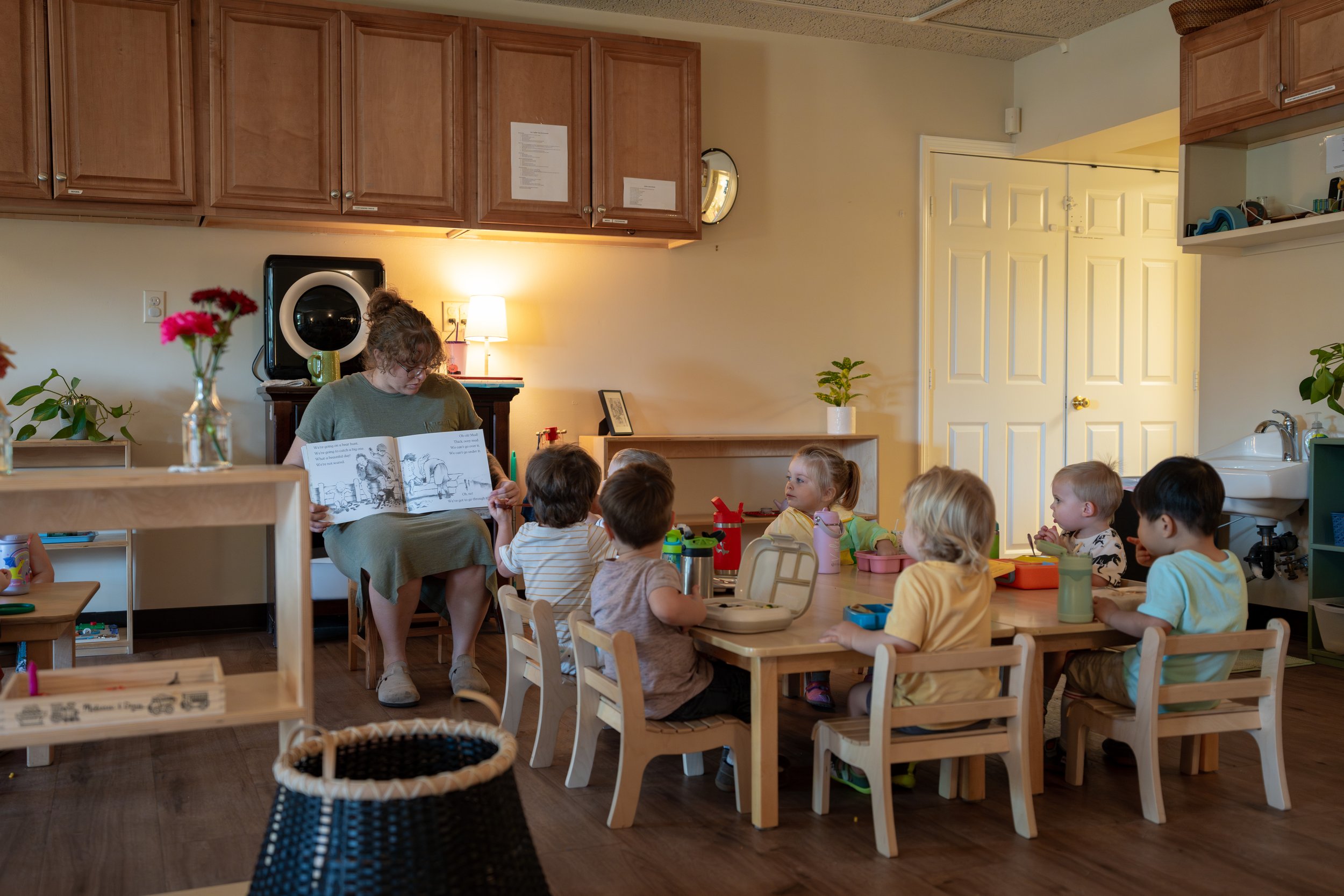
Toddler Community
Our Toddler Montessori Program offers a nurturing and engaging environment tailored to the unique needs of young learners ages 15 months (and walking) to three years. With two dedicated toddler rooms, we serve a maximum of 10 toddlers per room, ensuring personalized attention from our experienced team of two teachers in each room. Our program operates with flexible hours to accommodate various schedules, offering a half-day option from 8:30 AM to 12:00 PM and a full-day option from 8:30 AM to 3:00 PM. Through hands-on activities and a carefully prepared environment, we foster independence, curiosity, and a love for learning in our toddlers.
What Your Toddler Will Experience:
1. Practical Life Skills: Toddlers engage in everyday practical life activities such as putting on and taking off their shoes, serving themselves a snack and toilet learning, which all help develop independence, fine motor skills, and concentration.
2. Sensorial Exploration: Toddlers learn through their senses and explore concepts such as size, shape, color, and texture, laying the foundation for future learning.
3. Language Development: Our program introduces toddlers to language through stories, songs, and vocabulary-building activities, helping them develop communication skills and a love for reading.
4. Early Math and Number Concepts: Toddlers are introduced to early math concepts through singing, sorting, and matching materials, fostering a strong foundation for future mathematical understanding.
5. Social and Emotional Development: In our toddler community, children learn to interact with peers, express their emotions, and develop important social skills such as sharing, taking turns, and problem-solving.
-
The Toddler Community is designed to support children ages 15 months to 3 years as they begin to explore independence, social interaction, and purposeful work. To ensure readiness and safety in the classroom, the following requirements must be met:
Age & Developmental Readiness
Children may enter the Toddler Community as early as 15 months, continuing until age 3. Readiness is determined by both age and developmental indicators, including mobility, communication, and ability to separate from parents with support.Walking
For safety and full participation in the classroom, children must be walking steadily and unassisted within the classroom. If it is determined that a child is not yet walking enough to move safely and confidently in the environment, we may request to postpone their start date until they are ready.Toileting
Toileting is an essential part of the Toddler Community. The goal is for children to begin anticipating their own bodily functions and gradually move toward independence. While children will not enter immediately in underwear, they begin the toileting process soon after joining. This process involves building comfort with routines, transitioning from pull-ups to cloth underwear when appropriate, and working in partnership with families to ensure consistency between home and school.Separation & Transition
Children should be able to transition into the classroom routine with support from the guides. Consistent drop-off routines help children feel secure and allow them to build trust with the adults in the community.Independence Skills
Even at this young age, children are expected to begin developing independence in caring for themselves. This includes participating in dressing, helping with toileting routines, assisting with snack and meal routines, and engaging in purposeful work within the classroom.
-
In a Montessori environment, the Work Cycle is an uninterrupted period of focused work time—typically at least an hour to an hour and a half in the Toddler Community—during which children explore the classroom through purposeful activity. The adults in the community are present to guide rather than “teach” in the traditional sense. They serve as part of the prepared environment by modeling behavior and language, gently guiding children into meaningful work, supporting independence through collaboration, and embracing the natural curiosity of each child.
The guide offers lessons on prepared activities and carefully observes the child while they work. Through these observations, the guide can provide appropriate materials and guidance that challenge each child at their individual level. This process allows children to develop concentration, build skills, and seek joyful, purposeful work that nurtures self-discipline and independence.
It is essential that your child arrive on time to participate in the full Work Cycle. Consistency at the start of the day supports their development and helps maintain a peaceful and productive environment for all. Arriving late disrupts not only your child’s rhythm but also the flow of the community. For this reason, if you are unable to arrive before 10:00 a.m. on a given day, we ask that your child remain at home for that day.
-
Leaving a crying child can be very difficult. Some children have trouble separating from a parent, and if an adult displays any sign of uneasiness—through body language, energy, or facial expressions—the child will often pick up on that and feel the same sense of unease. It is important to acknowledge your child’s emotions using simple, clear language. For example, you might say:
“I know it is hard to say goodbye. You do your work, and I’ll do my work, and I’ll be back to pick you up after lunch/nap. Then we get to make dinner together. I love you. Bye.”
The quicker the drop-off, the easier it usually is for the child to calm down and settle into the routine. In most cases, once the parent is out of sight, the child becomes calm. Please try not to return to check on your child after leaving, even if they are crying. If you would like to receive a message letting you know how your child is doing, this can certainly be arranged.
It is also very important to always say goodbye when you leave. Sneaking out without saying goodbye can create feelings of insecurity or abandonment, which may make future drop-offs more challenging. The adults in the community are here to assist in any way possible to make this transition smooth for you and your child. Saying goodbye before leaving helps create consistency, trust, and a more positive drop-off experience.
-
Toileting is an essential part of the Toddler Community. The ultimate goal is for each child to begin anticipating their own bodily functions and to use the toilet independently throughout the day.
The toileting process begins as soon as a child joins the community, though they will not move immediately into underwear. First, the child establishes trust with the adults and becomes comfortable with the daily routine. At that point, we begin observing and discussing progress with toilet use at school and success with staying dry in a pull-up. Once this consistency is established, the child will begin wearing cloth underwear at school. Cotton allows children to feel the natural discomfort of being wet, helping them connect the sensation with the need to use the toilet.
During this transition, it is important to keep enough clean underwear and pants/shorts at school, as children often go through multiple changes each day in the early stages.
At home, you can support toileting by following a regular routine that works for your child. Encourage your child to sit on the toilet after meals, after being changed, before and after naps or bedtime, and before or after outdoor play. Invite your child to participate in the process by throwing away their wet pull-up, retrieving a clean one, and helping to pull up their pants. Having a dedicated space at home, where these items are accessible at your child’s level, fosters independence in toileting and self-care.
Once your child begins wearing underwear, it is important not to return to pull-ups or diapers during the day. If your child still uses pull-ups for naps or nighttime, have them change immediately upon waking and offer a chance to sit on the toilet before changing into underwear.
Consistency between home and school is key. When the process is supported in both environments, children gain confidence, develop independence, and experience success with toileting.
-
Before your child begins in the Toddler Community (TC), we will hold an introduction meeting for the family, child, and guides. During this visit, parents will receive a tour of the classroom, a detailed overview of the daily routine, and an opportunity to ask questions about the environment and upcoming transition. This time also allows the child to explore their new space and begin building a connection with the guides while parents remain nearby for reassurance.
The child will then begin a slow transition into the community. Below is a general guideline for the transition process. We use this schedule as a flexible framework and observe the child daily to determine how they are adjusting and what supports or changes may be needed for the following day.
• Day One - The parent drops off the child in the morning for about one hour.
• Day Two - The parent drops off child in the morning, a little longer than the previous day, and likely through both inside work cycle and outside time (about 2 hours).
• Day Three - The parent drops child off in the morning and the child stays until lunch.
• Day Four - The child is dropped off by the parent in the morning and the child stays through lunch.
• Day Five - The child stays for their full schedule. If the child is full-day, the parent should be available to pick up the child when he/she wakes from nap.
Families will receive a daily email update during the transition period, including a few photos, a short description of the child’s day, and a plan for the next day. Each child’s adjustment is unique and may vary depending on their previous group-care experience, temperament, and comfort level. Our goal is to make this experience positive, individualized, and supportive for both the child and family.
Please allow for flexibility during your child’s time of transition, as we carefully follow their lead to ensure the smoothest possible adjustment. We also ask that families remain flexible throughout the first few months of enrollment, as some children may need additional time to fully transition into the community.


